
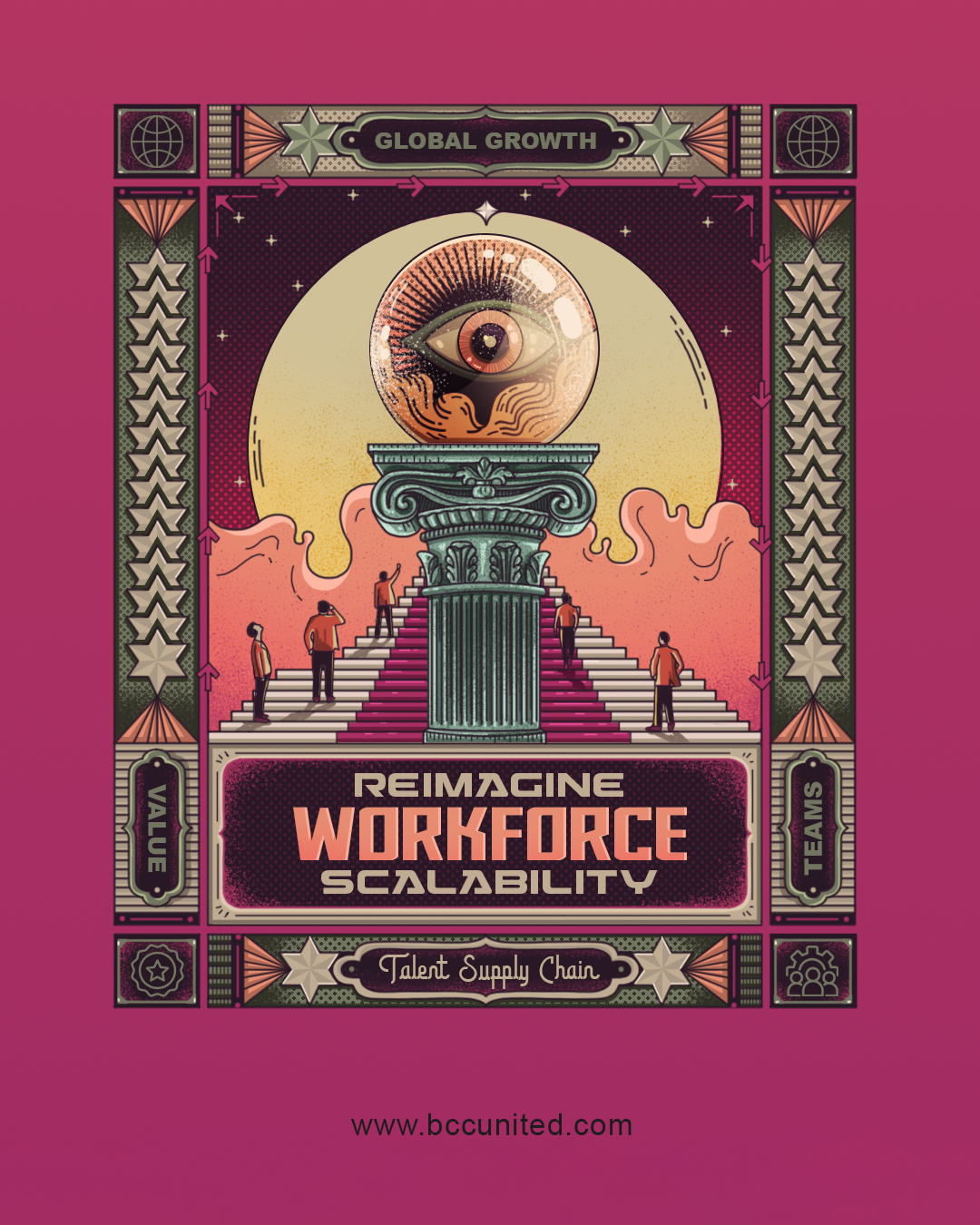
Does your business’s current workforce strategy truly match market velocity? Traditional, reactive hiring fails the modern enterprise. Scaling talent now demands the precision once reserved for product supply chains. This is why the Talent Supply Chain is essential. It’s an evolved framework aligning acquisition and development with business rhythm. Capability, not headcount, defines agility. A McKinsey Global Survey found that 87% of executives face a critical skills gap.
The ManpowerGroup reports 74% of employers struggle to fill roles on time, proving reactive hiring no longer works. The Talent Supply Chain resolves this challenge.
It treats human capital as a performance-linked, renewable asset. The system integrates forecasting, compliance, and global access into one intelligent ecosystem. This builds resilience and scalability into enterprise growth, turning workforce planning into a measurable competitive advantage.
Strategic Imperative: Why the Model Drives Competitive Advantage
Sustained enterprise growth demands a recruitment model that scales across business cycles. A Talent Supply Chain transforms hiring into a strategic capability. It links workforce planning directly with enterprise performance and innovation. This protects against volatility and builds lasting competitiveness. Let’s explore why this shift is vital.
- Overcoming Local Limits: Local talent markets rarely provide specialised skills fast enough for global demand. Expanding sourcing boundaries accelerates innovation, shortens hiring cycles, and enables follow-the-sun collaboration that keeps projects continuously moving.
- Ensuring Global Stability: International growth introduces complex payroll, tax, and compliance obligations. Integrated governance ensures consistent oversight across every market. This aligns local practices with global standards and maintains operational security.
- Transforming Cost into Capability: Traditional hiring treats labour merely as an expense. This strategic talent ecosystem treats it as growth capital. It connects experts to critical programs when required. This fuels faster launches and continuous R&D momentum.
Case Study: Published by Deloitte Insights, this study examined how global enterprises like Google and Toyota tackled tech-talent shortages by shifting from static hiring cycles to continuous workforce planning. Using predictive analytics and global capability centres, these firms unified governance, compliance, and multiregional access. The result: a 10% productivity gain, 25% lower labour costs, and measurable innovation speed. By embedding forecasting and agility into their talent model, they turned workforce planning into a sustainable engine of enterprise performance and long-term competitiveness.
By building a unified, governed workforce model, enterprises gain lasting control and foresight. The next step is engineering an architecture that sustains scalability—anchored in forecasting precision, leadership continuity, and consistent global quality.
Building the Architecture: Defining Recruitment Design
A resilient recruitment architecture defines how talent moves through the enterprise. It builds precision in forecasting, leadership acquisition, and process maturity—creating predictable pipelines that align workforce strategy with business goals and sustain global scalability.
- Strategic Blueprint Design: Staffing consulting maps future workforce needs and identifies cross-functional skill gaps. It connects internal development and external hiring, creating a balanced framework that scales smoothly and adapts to evolving demand.
- Securing Decisive Leadership: Global expansion requires decisive leadership across cultures and time zones. Executive search places leaders who can manage multi-regional teams, preserve enterprise culture, and ensure performance continuity worldwide.
- Predictable Quality Control: Recruitment process outsourcing introduces standardised workflows and measurable SLAs. Integrated assessments maintain hiring speed and consistency across regions, ensuring every hire meets enterprise quality benchmarks and compliance expectations.
Case Study: Published by Randstad Enterprise, a global life-sciences company was struggling with fragmented hiring and weak governance across 28 countries. Randstad built a centralised talent framework that unified permanent and contingent recruitment while enforcing compliance and embedding analytics for workforce forecasting. The program delivered 5,000+ hires annually, consolidated 85% of global talent intake, and managed €100 million+ in workforce spend. What began as HR optimisation became a strategic growth engine, redefining recruitment as a measurable driver of enterprise performance.
Once the architecture is established, execution becomes the true differentiator. The next phase converts strategic design into measurable performance—powered by flexible workforce models that preserve agility, scalability, and operational excellence.
Operational Excellence: Leveraging Flexible Workforce Models
A sound architecture becomes real through execution. A flexible workforce model delivers scalability, specialisation, and brand continuity—keeping teams responsive while sustaining measurable performance across markets and business cycles.
- Elastic Capacity and Stability: Contract staffing enables rapid ramp-ups for time-bound initiatives. Permanent roles preserve institutional knowledge and culture. Together, they deliver agility with continuity—so programs scale without compromising standards or long-term capability.
Case Study: As published by CSMS Group, a global automobile manufacturer entering India scaled operations through a flexible workforce model. CSMS introduced a blended design—contract talent for rapid deployment and permanent roles for continuity. This structure accelerated readiness while reducing hiring costs by 50 percent. Over 70 percent of the workforce was engaged on contract. The model proved how agile staffing architecture delivers elasticity, cost efficiency, and operational stability without compromising quality.
- Sourcing Niche Expertise: When local markets fall short, cross-border specialised-skill staffing fills critical gaps. It delivers scarce competencies on demand, shortens hiring cycles, and keeps strategic programs moving at enterprise speed.
Case Study: As published by People2.0, a global staffing firm supporting a major tech client needed to staff a high-skill project in Singapore without local presence. People2.0 delivered a full Employer-of-Record (EOR) solution—managing recruitment, payroll, compliance, and training—within 45 days. The project onboarded 18 technical professionals, with 75 percent of accepted candidates placed and full legal compliance achieved. This rapid, precise execution proved how specialised cross-border staffing can combine speed, skill, and scalability for enterprise-level projects.
- Protecting Employer Reputation: Transitions shape perceptions. Outplacement services support departing employees with dignity, protect brand equity, and maintain trust—preserving attraction and retention during restructures or portfolio changes.
Case Study: Published by Right Management, this case details how a global consumer goods company safeguarded its employer brand during a facility closure through on-site outplacement programs. Workshops, one-on-one coaching, and career fairs with 18 employers helped displaced employees transition smoothly. The result: 71% secured new roles before project completion, and satisfaction reached 97%. By combining empathy with structure, the company preserved community trust and proved that workforce transitions—when handled with care—can strengthen, not strain, employer reputation.
Once flexibility is achieved, governance sustains it. True operational excellence requires disciplined oversight. This tracks value, ensures compliance, and drives continuous improvement, maintaining an agile talent ecosystem.
Governance and Continuity: Maintaining Long-Term Agility
Governance frameworks convert flexibility into sustained performance. They safeguard compliance, ensure visibility across markets, and drive continuous improvement throughout the Talent Supply Chain—creating an ecosystem where agility and accountability coexist.
- Data-Driven Decision Frameworks: Modern governance applies analytics to monitor productivity, engagement, and talent ROI. Predictive dashboards translate workforce data into foresight—empowering faster, evidence-based staffing decisions.
- Integrated Compliance Ecosystem: Centralised governance unifies hiring, payroll, and data policies across regions. Transparent audit trails strengthen regulatory trust and safeguard brand credibility at scale.
- Continuous Improvement Culture: Structured feedback loops between HR, business units, and leadership fuel adaptability. With governance as the guide, organisations evolve their workforce strategies without disrupting operational flow.
Case Study: Catalight partnered with Workday to unify its HR and finance governance under a single system of record. Real-time dashboards now provide visibility into compliance, hiring, and performance across its 14,000-practitioner network. The results are measurable: time on strategic work rose from 10% to 25%, organisational changes executed 50% faster, and job-requisition cycles reduced 64%. By embedding analytics and standardised workflows, Catalight turned fragmented processes into a governed rhythm of agility and accountability—proving that data-led governance sustains growth without sacrificing control.
Why BCC-United?
At BCC-United, we help enterprises Reimagine Workforce Scalability by building end-to-end ecosystems that connect strategy, talent, and technology. Our Talent Supply Chain model integrates staffing consulting, executive search, and specialised skill sourcing to create unified, future-ready teams.
We combine global Payroll & Compliance with performance governance, ensuring scalability without risk. Our frameworks turn workforce planning into a strategic growth lever—delivering operational speed, leadership continuity, and measurable business outcomes. With BCC-United, your talent strategy becomes your competitive edge, empowering your enterprise to scale confidently and lead decisively in every market.